
How Many Vocabulary Words Should Your Child Learn Each Week for the 11+ Exam?
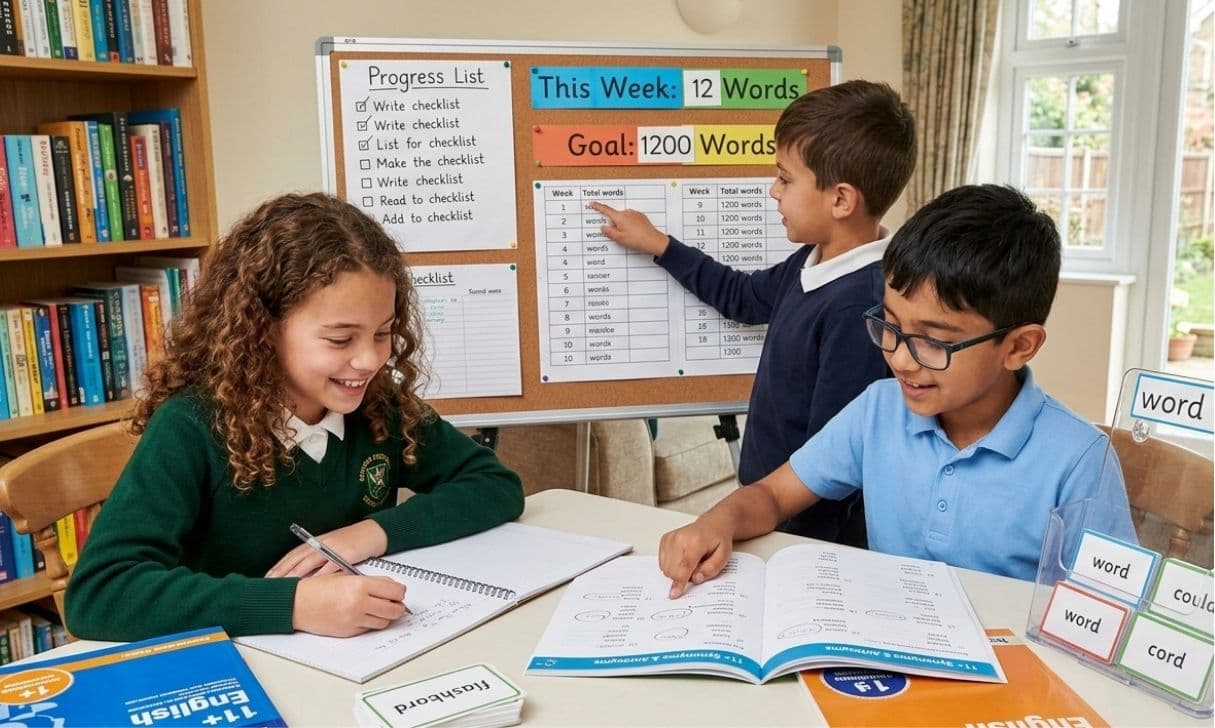
One of the most common questions parents ask during 11+ preparation is:
“How many vocabulary words should my child learn each week?”
Vocabulary plays a major role in the 11+ exam. A strong vocabulary helps children understand comprehension passages, recognise synonyms and antonyms, and express ideas clearly.
However, learning too many words too quickly can overwhelm a child, while learning too slowly may not build enough vocabulary before the exam.
So what is the right balance?
This guide explains how many words per week works best and how that pace translates into learning 600, 1200, or even 1800 words over time.
Why Vocabulary Learning Should Be Consistent
Children between the ages of 8 and 11 learn best through steady and repeated exposure rather than large bursts of new information.
Learning research shows that a child typically needs multiple encounters with a word before it becomes part of their active vocabulary.
This means vocabulary learning works best when it focuses on:
• manageable weekly targets
• repeated exposure to difficult words
• steady progress over time
Consistency matters far more than speed.
Recommended Weekly Vocabulary Pace
For most children preparing for the 11+, the following learning pace works well.
Learning 10 words per week is a comfortable pace that allows children to steadily build vocabulary without pressure.
Learning 15 words per week creates faster progress while still remaining manageable for most students.
Learning 20 words per week is suitable for motivated learners who can maintain a slightly more intensive study routine.
Learning 25 words per week is a challenging pace that may work for highly committed students but can feel demanding for many children.
In practice, many children perform best when learning 10 to 15 new words each week, combined with regular review.
How Weekly Learning Builds Vocabulary Over Time
Small weekly goals add up quickly over time. Even learning just a few words every week can lead to hundreds of new words within a year.
If a child learns 10 words per week:
• 600 words can be completed in about 60 weeks, which is roughly 1 year and 2 months
• 1200 words can be completed in about 120 weeks, which is roughly 2 years and 4 months
• 1800 words can be completed in about 180 weeks, which is roughly 3 years and 6 months
If a child learns 15 words per week:
• 600 words can be completed in about 40 weeks, which is roughly 9 months
• 1200 words can be completed in about 80 weeks, which is roughly 1 year and 6 months
• 1800 words can be completed in about 120 weeks, which is roughly 2 years and 4 months
If a child learns 20 words per week:
• 600 words can be completed in about 30 weeks, which is roughly 7 months
• 1200 words can be completed in about 60 weeks, which is roughly 1 year and 2 months
• 1800 words can be completed in about 90 weeks, which is roughly 1 year and 9 months
If a child learns 25 words per week:
• 600 words can be completed in about 24 weeks, which is roughly 5 to 6 months
• 1200 words can be completed in about 48 weeks, which is roughly 11 months
• 1800 words can be completed in about 72 weeks, which is roughly 1 year and 4 months
These examples show how small weekly goals can lead to significant vocabulary growth over time.
What Vocabulary Size Is Ideal for the 11+?
Different vocabulary targets can represent different levels of preparation.
600 words provides a strong foundation vocabulary that supports comprehension and basic vocabulary questions.
1200 words usually represents strong preparation and allows children to recognise a wider range of synonyms, antonyms, and complex vocabulary used in exam questions.
1800 words represents vocabulary mastery and gives children a wide vocabulary that strengthens reading, writing, and exam performance.
Why Learning Too Many Words at Once Can Backfire
Some parents believe learning large batches of vocabulary quickly is the best strategy. In reality, this often leads to lower retention and frustration.
Children may confuse similar words, forget meanings quickly, or lose motivation.
A child who learns 10 words consistently every week will often build a stronger vocabulary than a child who tries to memorise dozens of words at once.
Consistency almost always wins.
A Simple Vocabulary Plan for 11+ Preparation
For most families, a realistic and sustainable plan is:
• learn 10 to 15 new words per week
• practice vocabulary in short daily sessions
• regularly revisit words that were difficult
At this pace, many children can comfortably build a vocabulary of 600 to 1200 words during their preparation period, which provides strong support for the 11+ exam.
The Key to Vocabulary Success
The most effective vocabulary learning strategy is not speed but consistency.
Small weekly goals, combined with repetition and review, allow children to build a vocabulary that stays with them long after the exam.
Over time, those weekly words turn into hundreds of new words that strengthen reading, comprehension, and confidence.